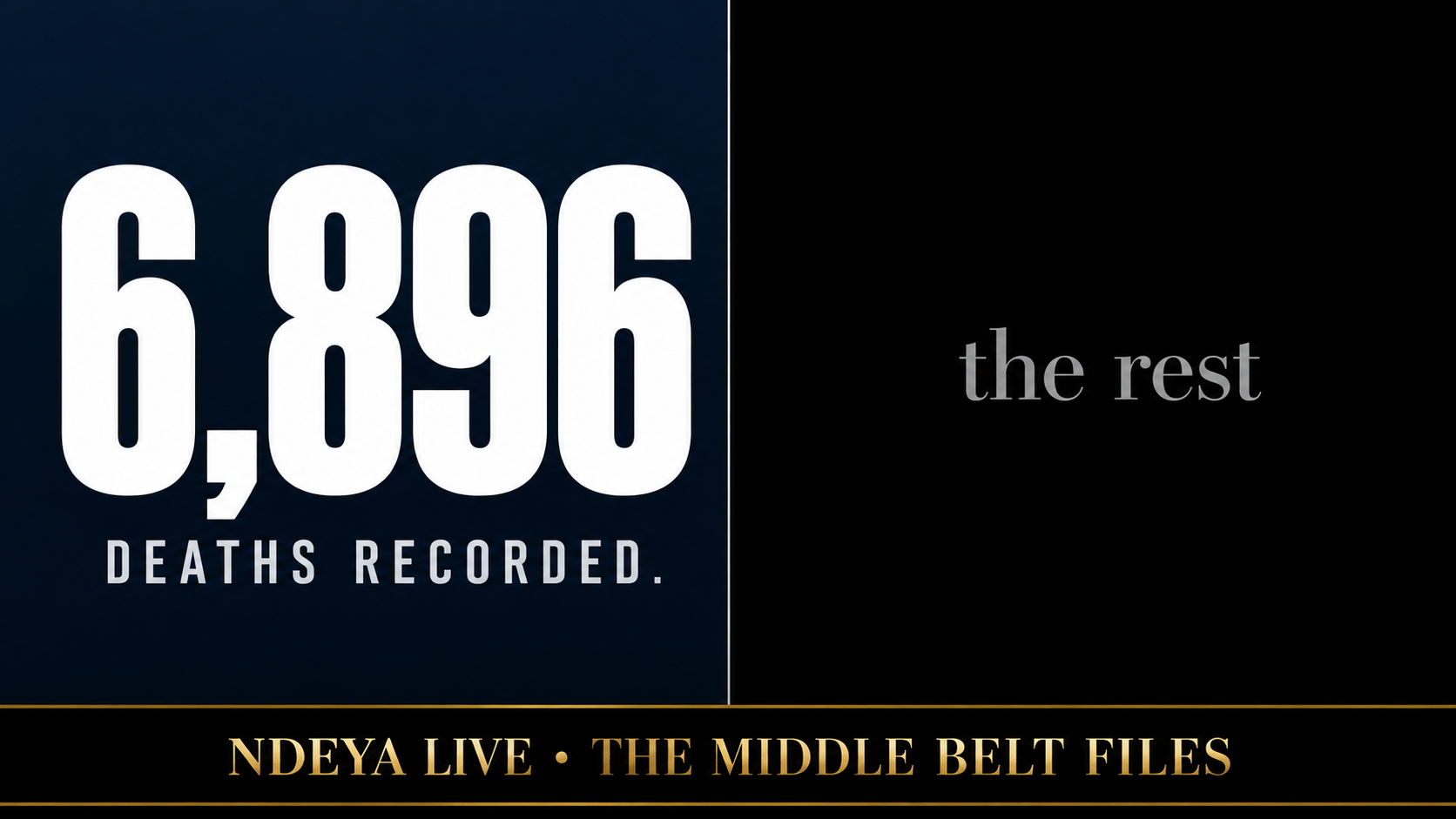
More than 50,000 people have died in Nigeria’s Middle Belt since 2011. In several of those years, the death toll exceeded Boko Haram’s. And yet the crisis has never triggered a federal emergency declaration, a dedicated reconstruction body, or a completed criminal prosecution for any of the major community attacks.
The death toll is not the whole story. It may not even be the most important part.
Episode 7 of The Middle Belt Files — a documentary series produced by Ndeya Live — sets the casualty record aside and examines four dimensions of the crisis that numbers alone cannot capture.
The generation born in displacement
Since the major attack waves of 2014 to 2016, hundreds of thousands of people have been displaced from farming communities across Benue, Plateau, and Nasarawa states. The displacement has not resolved. The three conditions required for dignified return — safety, voluntary choice, and functioning infrastructure — have not been met in any of the primary affected local government areas. No federal reconstruction programme equivalent to the Presidential Committee on North-East Initiative exists for the Middle Belt.
In that gap, a generation has been born. Children of displaced families — born in church compounds, unfinished buildings, and informal settlements — have no land rights in their parents’ communities, no administrative registration in their LGA of origin, and no clear legal pathway back. No Nigerian government body tracks them as a distinct category.
Sexual exploitation inside “truce” arrangements
In persistently insecure areas where security force protection has been inconsistent, communities have entered informal arrangements with armed groups in which reduced violence is exchanged for compliance. In documented cases — recorded by UNFPA, Catholic Caritas Foundation Nigeria, and field researchers — that compliance has included sexual access to women.
This is not negotiation. It is coercion structured as arrangement. The silence around it is enforced by the ongoing presence of perpetrators, social stigma that falls on survivors, and the calculation that the arrangement is providing some measure of protection. Clinical workers in the region report presentation rates far exceeding formal incident reports.
Cultural erasure
The Middle Belt’s agricultural economy and cultural calendar are not separate from one another — festivals mark planting and harvest cycles; craft traditions are transmitted within farming household structures. Both have been severely disrupted.
The Kwagh-hir dramatic tradition of the Tiv people — one of West Africa’s most sophisticated forms of community performance — requires intact, home-based communities to sustain. It cannot be performed in urban displacement settings. The Berom ceremonial calendar in Plateau State has been comprehensively disrupted. The Ngas Cultural Festival has not been held in full in recent years. The elders who hold these traditions are aging in displacement. When they die, the knowledge dies with them.
The electoral consequence
Nigeria’s voter registration is ward-based. Displaced persons remain registered in home wards they may not safely reach on election day. The communities bearing the heaviest displacement burden — indigenous farming communities in Benue and Plateau — are consequently the communities whose votes are least likely to be cast. Benue’s gubernatorial turnout in 2019 was 34.23 percent. National presidential turnout in 2023 fell to 26.72 percent — a historic low.
The feedback loop is structural: fewer votes produce less political attention, which produces less security spending, which sustains displacement, which suppresses votes further.
The argument
This is not primarily a security problem that generates humanitarian side effects. The removal — from land, from education, from civic participation, from cultural continuity — is the primary phenomenon. The violence is the mechanism through which removal occurs.
Understanding it as such changes what an adequate response would require.
Episode 7 of The Middle Belt Files is available now on the Ndeya Live YouTube channel.
A fully sourced research brief is available for download.