A new documentary series from Ndeya Live opens with the question Nigeria has avoided for over a century: what do you call the land between the north and the south?
By Rimamnde Shawulu | The Middle Belt Files, Episode 1
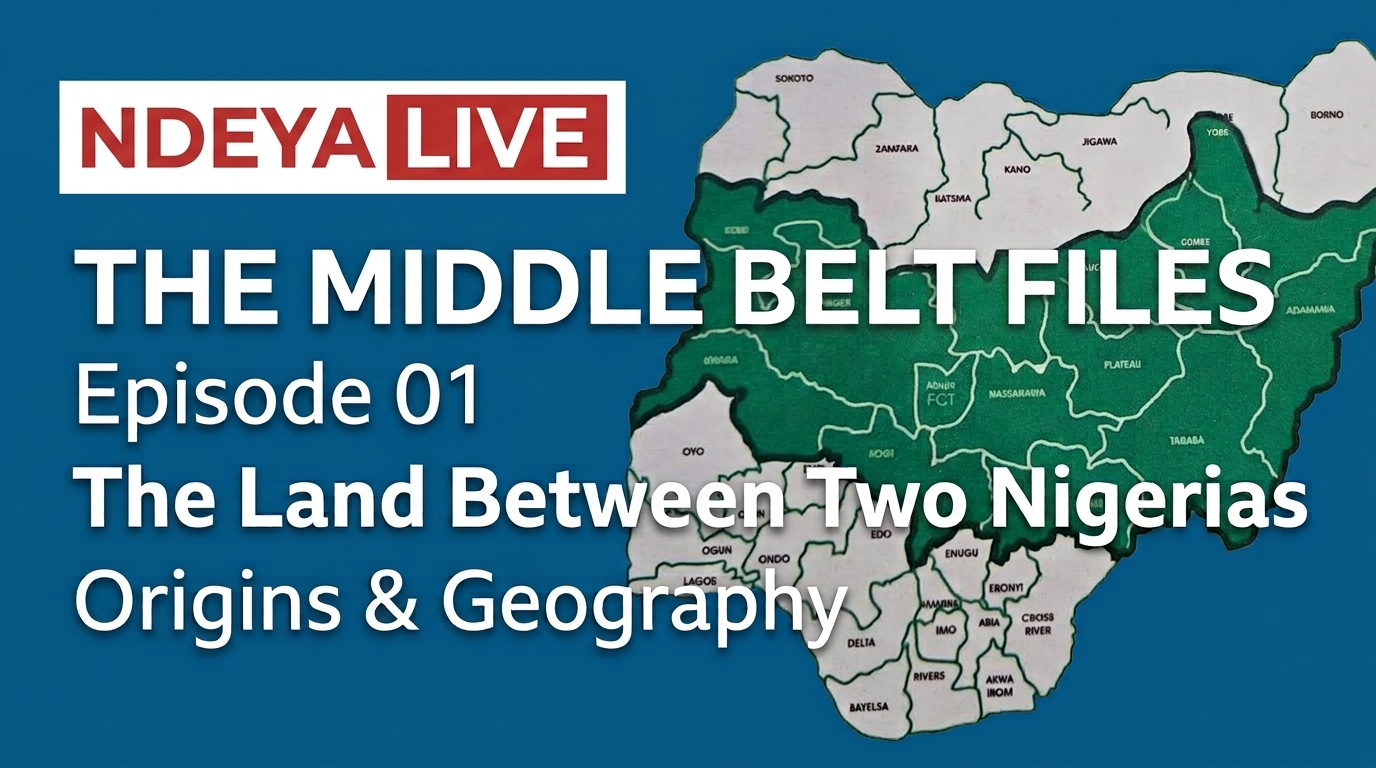
There is a region of Nigeria that does not appear on any government map, has no official boundary, and is home to somewhere between 45 and 60 million people — yet most Nigerians, and nearly all outside observers, could not tell you where it begins or ends. It is called the Middle Belt, and it is the subject of “The Middle Belt Files,” a new ten-episode documentary series from Ndeya Live that launches with a foundational question: what, exactly, is this place?
The federal government’s answer is administrative and narrow. It calls the area the North-Central zone, bundling Benue, Plateau, Nassarawa, Kogi, Niger, Kwara and the Federal Capital Territory into a single bureaucratic category. But Episode 1 argues that the Middle Belt as its own people understand it is far larger — stretching into Southern Borno, Southern Bauchi, Southern Kebbi, and parts of Taraba, Adamawa and Southern Kaduna, where the language, crops and culture shift away from their surrounding “official” zones entirely.
Drawn honestly, the numbers are striking: over 250 distinct ethnic groups and more than 230 languages — nearly half of every language spoken in Nigeria — packed into one stretch of territory. Benue State alone is home to more than five million Tiv people, one of the region’s largest single ethnic groups. Plateau State’s Jos Plateau, rising over 1,000 metres, shelters the Berom, Tarok, Mwaghavul, Angas and Sura. And in a detail most Nigerians have never been taught: the Gbagyi people, the original inhabitants of the land beneath Abuja, are themselves a Middle Belt community — meaning the seat of Nigeria’s federal government sits on Middle Belt soil.
NOT A CHRISTIAN BLOC, NOT A MUSLIM BLOC
One of the episode’s central corrections is religious. International coverage of the region routinely flattens it into a Muslim-north-versus-Christian-south story. The reality, the episode argues, is a mosaic: Christianity dominant in Plateau and Benue through the legacy of early-20th-century missions like the Sudan Interior Mission; Islam dominant among the Nupe of Niger State and the Ebira of Kogi; a Muslim-majority north and more mixed south within Kwara State itself; and indigenous traditional religions practiced throughout, often woven into Christian or Muslim life simultaneously — a pattern the episode calls religious syncretism.
That complexity matters for understanding the violence that later episodes will document in detail. Muslim Nupe communities have not been attacked in the pattern that Christian Berom communities have; the geography of attacks tracks ethnic land boundaries, the episode argues, not religious ones.
A FRONTIER THAT WAS NEVER CONQUERED
The history laid out is unsparing. In 1804, Usman dan Fodio’s Sokoto Jihad built an Islamic caliphate across the far north — but Middle Belt communities like the Tiv, Berom and Jukun were never fully absorbed, becoming instead what historians call a “raiding frontier”: enslaved and taxed, but never conquered. Then, in 1914, British colonial administrators amalgamated northern and southern Nigeria into one country and placed Middle Belt peoples under northern governance — a decision the episode calls “one of the most consequential errors in Nigerian history.” By the 1950s, Tiv politician Joseph Tarka and the United Middle Belt Congress were demanding separate political recognition, a demand the episode says was “partially heard” through state creation but “never fully answered.” From 2011 onward, long-simmering local disputes escalated into mass violence — by 2018, the episode notes, more people were dying annually in the Middle Belt than in the entire Boko Haram insurgency in the northeast. The world noticed one. It largely ignored the other.
THE CONFLICTS NO ONE TALKS ABOUT
Perhaps the most striking section of the episode is its refusal to romanticize the region. The Middle Belt, it insists, has a documented history of violent conflict within itself — not just from external attackers. The Tiv and the Jukun fought bloody clashes in Taraba through the 1990s and 2000s over farmland along the Benue River. The 2001 Jos crisis, which killed more than a thousand people, began not over cattle but over a disputed local government appointment. The 1992 Zangon-Kataf crisis in Southern Kaduna, rooted in land ownership and the contested legal status of “indigene” versus “settler,” left hundreds dead in days. The Tiv and the Igede, the Ngas and the Mwaghavul — neighboring communities with their own unresolved land and water disputes — round out a picture the episode summarizes bluntly: “The Middle Belt cannot be romanticised into unity.”
CLAIMED BY THE NORTH, IGNORED BY THE SOUTH
The episode closes by examining how the rest of Nigeria sees — or fails to see — the region. Southern Nigerians, it argues, oscillate between three misreadings: treating Middle Belt Christians as political allies on religious grounds alone, dismissing the violence as “a northern problem,” or suggesting the region simply join the south — missing that Middle Belt identity is defined by refusing absorption into either bloc. Northern political structures, meanwhile, have long folded the region into a “One North” coalition that Middle Belt leaders say delivers demographic weight without real power-sharing, while staying conspicuously silent when Fulani-affiliated armed groups are implicated in attacks. The result, the episode argues, is a region “made politically invisible by the very people whose recognition it needs” — most visibly when hundreds were killed on Christmas night 2023 and national coverage moved on within a week.
Episode 1 sets up the rest of the series with a promise: the numbers behind that silence, and the question of who is actually dying and why, come next. But even on its own, the episode reframes a region most viewers have never had properly explained — its people, its faiths, its buried conflicts, and the century of political decisions that made it invisible.
WATCH THE FULL EPISODE
See the maps, the archival history of the 1804 jihad and 1914 amalgamation, and the voices explaining what it actually means to be asked, your whole life, “are you northern or southern?”
Click here to Watch : The Middle Belt Files, Episode 1 — Ndeya Live YouTube