
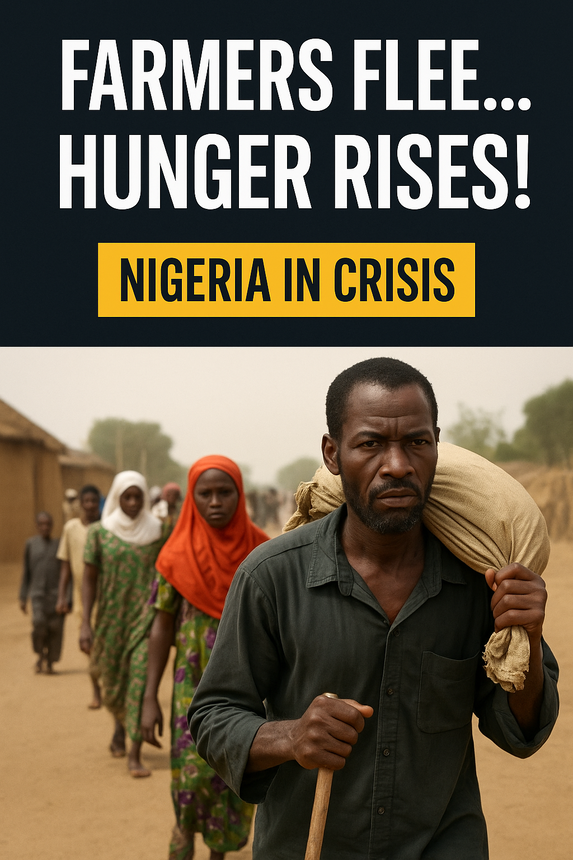
Africa is entering another dangerous cycle of food insecurity, and this week’s Security Update reveals worsening indicators across Nigeria and the continent. According to Reuters, 35 million Nigerians are now at risk of severe hunger, driven by escalating insurgent attacks, shrinking humanitarian funding, and the collapse of farming activities across major food-producing regions.
In Nigeria, the crisis deepened after insurgents killed a Brigadier General in the Northeast, and armed bandits abducted over 300 Catholic schoolchildren, barely one week after kidnapping 25 schoolgirls in Kebbi. Families in Plateau, Benue, Nasarawa, Kogi, and Taraba continue to abandon their farms, while others now pay armed warlords to harvest crops.
In Katsina, 20 local government areas have signed informal peace deals with bandits who still carry arms openly—highlighting state weakness and a shrinking security presence. Across Africa, extremist violence is accelerating food emergencies.
The Al-Qaeda–linked JNIM, now expanding into Nigeria, carried out its first recorded attack in Kwara State, killing a soldier. This comes as the group threatens government stability in Mali and embeds deeper into the Sahel. ISWAP attacks continue in the Lake Chad region, further disrupting farming and humanitarian operations.
The global context is equally troubling: the World Food Programme faces a funding cliff, largely due to declining U.S. contributions. As African needs rise, support is falling. Historical trends show a continent repeatedly struck by hunger—from Ethiopia (1972–75, 1983–85), to Somalia (1991–92, 2007–08), Sudan (1983, 1998), Niger (2005), Malawi (2002), and Southern Africa (2016–17).
Today, projections suggest that by 2026, one in five Africans will face hunger, even as global hunger declines. Patterns show clear drivers: conflict, denial of conflict, governance failures, weak legislatures, corruption, climate variability, and poor crisis response.
Despite recurrent droughts and floods, other arid nations like Israel, Saudi Arabia, and the UAE have achieved food stability through governance reforms, irrigation systems, artificial lakes, and agricultural innovation.
Africa’s crisis is therefore a governance problem, not merely a climate problem.
This week’s Security Update concludes with a warning: unless African governments rebuild institutions, secure rural communities, and invest in sustainable food systems, the continent may experience one of its worst hunger crises in decades. Subscribe to Security Update for verified weekly reports on Nigeria, Africa, and the world